

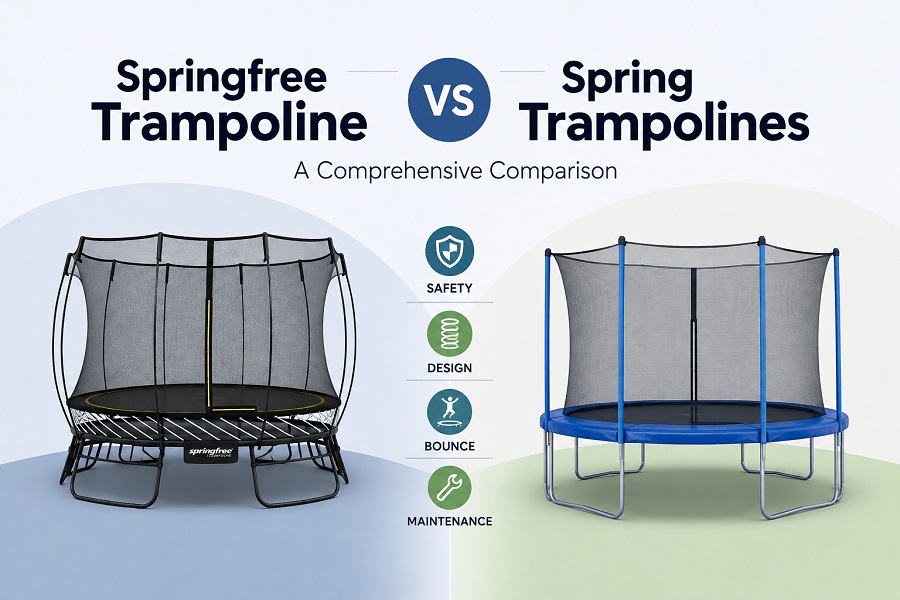
When it comes to choosing the right trampoline for your backyard, you’ll encounter two main types: the innovative Springfree trampoline and the traditional spring-based alternatives. Both offer fun and exercise opportunities for the whole family, but they differ significantly in design, safety, performance, and cost. Understanding these differences will help you make an informed decision that best suits your family’s needs.
The Fundamental Difference
The most obvious distinction between these two types lies in their construction. Traditional spring trampolines use metal coil springs to create tension and propulsion, while Springfree trampolines use a unique rod-based suspension system. Springfree replaced metal springs with composite rods positioned under the jumping surface, fundamentally changing how the trampoline functions and performs.
This design innovation wasn’t arbitrary. It was developed specifically to address the safety concerns and limitations associated with traditional spring systems. The result is a trampoline that operates on entirely different principles, offering distinct advantages and trade-offs that warrant careful consideration.
Safety: A Major Advantage for Springfree
Safety is perhaps the most significant factor when choosing a trampoline, especially for families with children. This is where Springfree truly shines. Traditional spring trampolines have a notorious reputation for injuries, with the American Academy of Pediatrics warning against their use for children under six. The springs themselves pose hazards. Fingers and limbs can get pinched between coils or caught between springs and the frame.
Springfree trampolines eliminate these pinch points entirely. Without exposed springs, metal edges, or frame gaps, the injury risk is substantially reduced. The design also means no missing springs or loose hardware that could deteriorate over time. Additionally, Springfree trampolines come standard with a soft, padded safety frame that covers the perimeter completely, providing extra protection if a jumper falls off.
Spring trampolines offer safety nets as optional add-ons, but these aren’t always as effective at preventing injuries. The frame-to-surface gap that creates pinch points remains regardless of safety netting.
Durability and Maintenance
When comparing longevity, the stories diverge. Spring trampolines require regular maintenance to remain safe and functional. Springs weaken over time, lose tension, and can rust, especially in humid climates. Rust accelerates deterioration and can eventually cause springs to snap. The jumping mat also typically lasts only 3-5 years before needing replacement due to UV exposure and constant stress.
Springfree trampolines feature composite rods that don’t rust and maintain their integrity for much longer. The jumping mat is typically more durable as well. However, Springfree comes with a premium price that reflects this extended lifespan. When you calculate the cost per year over the trampoline’s life, the gap narrows considerably, though Springfree still tends to be more economical long-term due to fewer replacements and repairs.
Bounce Quality and Performance
Here’s where traditional spring trampolines have traditionally held an advantage. Many trampoline enthusiasts argue that spring systems provide a more responsive, “snappy” bounce. Springs compress and release quickly, creating that classic trampoline feel that many grew up with.
Springfree’s rod-based system provides a different bounce experience. Many describe it as softer and more forgiving. This characteristic actually has safety benefits, as it reduces the jarring impact on joints. However, some experienced jumpers and acrobatic enthusiasts may find they prefer the traditional spring bounce.
That said, Springfree has continuously refined its rod technology, and newer models perform quite well for recreational jumping and basic tricks. For casual family use, most users find the bounce quality entirely satisfactory.
Cost Considerations
Price is often the deciding factor for many families. Spring trampolines are significantly cheaper upfront, ranging from $200-$600 for mid-range quality models. Springfree trampolines start at around $500 and can exceed $3,000+ for larger, premium models.
However, when calculating total cost of ownership over 10-15 years, the equation changes. Spring trampolines require spring replacements ($100-$300), mat replacements ($150-$400), and frequent maintenance. Springfree’s higher initial investment translates to fewer replacements and repairs, potentially evening out the total investment over time.
Who Should Choose Each?
Spring Trampolines are ideal for:
- Budget-conscious families
- Those seeking the traditional trampoline bounce experience
- Families with older children (teen gymnasts who appreciate spring responsiveness)
- Temporary or short-term setups
- Those willing to maintain the equipment regularly
Springfree Trampolines are ideal for:
- Safety-conscious families with young children
- Those wanting minimal maintenance
- Families seeking a long-term backyard investment
- People in humid or coastal climates where rust is a concern
- Those willing to invest more upfront for peace of mind
Verdict
The choice between Springfree and spring trampolines ultimately depends on your priorities and budget. If safety and low maintenance are paramount, and you can afford the higher upfront cost, Springfree is the superior choice. Its innovative design eliminates traditional hazards and promises years of worry-free use.
However, if you’re budget-limited, expect to perform regular maintenance, and prefer the classic spring bounce, a quality traditional spring trampoline remains a viable option—just ensure you follow strict safety protocols, including consistent inspection and the use of safety nets.
Regardless of which you choose, proper supervision, safety rules, and regular maintenance are essential. A trampoline can provide years of family fun and exercise, but only when chosen thoughtfully and used responsibly.
